This site presents results of tests that compare the properties of different types of steel used to make blades for woodworking planes.
I’m attempting to answer these questions:
- With equally fine honing, do some blades reach a higher level of sharpness than others?
- Which honing abrasives work best on each type of steel?
- How well do the blades hold an edge when used to plane different species of wood?
- What bevel angles give the best performance?
I’ve tested a number of blades from commercial manufacturers and blades I made myself from a particle metallurgy alloy called CPM 3V.
I have a related site called Tuning & Testing Infill Planes that describes my efforts to learn how to bring an infill plane to a high level of performance.
Methods of Testing
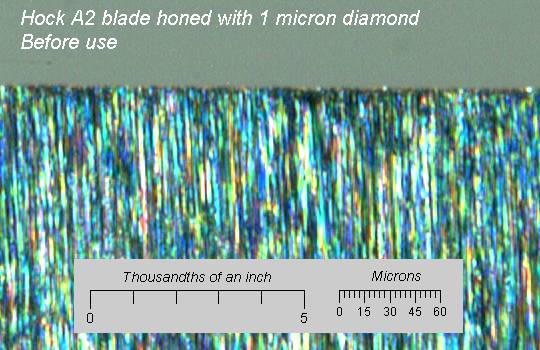
To check the quality of a freshly honed edge and ensure that remnants of a wire edge have been removed I’m using a digital inspection microscope that gives images at 540 power. After the blade has planed a measured amount of the test species I examine it again to check for chipping, deformation, and wear. Here is an image of a freshly sharpened blade edge:
This is the same edge after making 400 lineal feet of shavings:
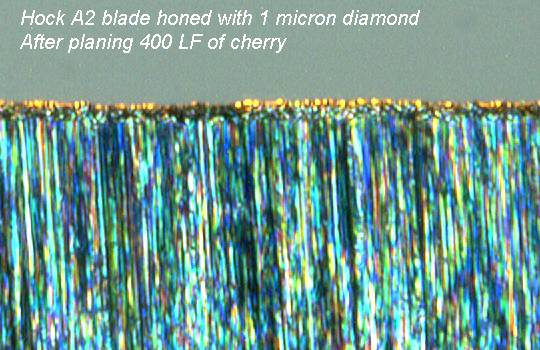
Each of these shows a small portion of a much larger image and represents less than 1/64” of the blade edge. They magnify the lower or clearance surface of the blade edge, which is a good indicator of blade wear.
The width of this wear surface on the clearance side of the blade is used by Leitz, a major manufacturer of sawblades and cutters for woodworking tools, as a measure of blade dullness and is the method used by a fellow blade tester named Brent Beach who has done extensive testing of plane blades and reported the results on his website.
In addition to making microscope images I sometimes test the sharpness of the blades by measuring the amount of force it takes for the blade to cut through a loop of thread. By performing repeated tests it’s possible to get a numerical value for the sharpness of the blade. Further information about this test can be found here.
Since microscope images cannot measure the sharpness of a freshly honed edge I use the thread-cutting test to compare the degree of sharpness a blade has reached when honed using different sharpening methods.
Updated 12 October 2020